Updated: 11:25 p.m. ET, Wed. Nov 12th.
Editor’s Note: We’ll be updating this post daily for the length of the shutdown fight with updates, ideas, insights, and—most importantly—what we can do. This could go on for a few more days, a few weeks, 35 days (Trump’s previous shutdown record), or more. We’ll send the usual occasional emails/push via the normal DisRev Newsletter, but if you want more frequent shutdown-related updates: Sign Up Here.
Day 43: This could be the final day
UPDATE: The shutdown is officially over. At about 10:26 p.m., the shutdown ended.
Trump answered no questions after he signed the bill. One reporter could be heard asking about Epstein.
The government will begin reopening immediately. Most federal workers will be due back in the morning.
Probably a good time to resurface this post from back in March:
Who should replace Schumer?

The Democratic Party is in free fall. A CNN poll put the party at a record low of 29 percent approval amongst the overall electorate. Worse still, about half of Democratic supporters believe the party’s leadership is headed in the wrong direction.
The House passed the shutdown deal by a vote of 222-209.
Six Democrats voted for it:
Rep. Adam Gray of California
Rep. Marie Gluesenkemp Perez of Washington
Rep. Jared Golden of Maine
Rep. Henry Cuellar of Texas
Rep. Tom Suozzi of New York
Rep. Don Davis of North Carolina
Two Republicans voted against it:
Thomas Massie of Kentucky
Greg Steube of Florida
This means that even if every Democrat voted against the package, it still would have past. I’d be interested to see how these six would have voted if their votes were a deciding factor. As things played out, I can see their perspective: It’s not worth burning the political capital when you’ve already lost this fight and you’re from a Trump district.
From the Dept. of No One is Surprised
Democrats took a handshake deal from Republicans for a Senate vote. No mention of a House vote. And now Johnson says there probably won’t be one.
Shocked. We’re shocked.
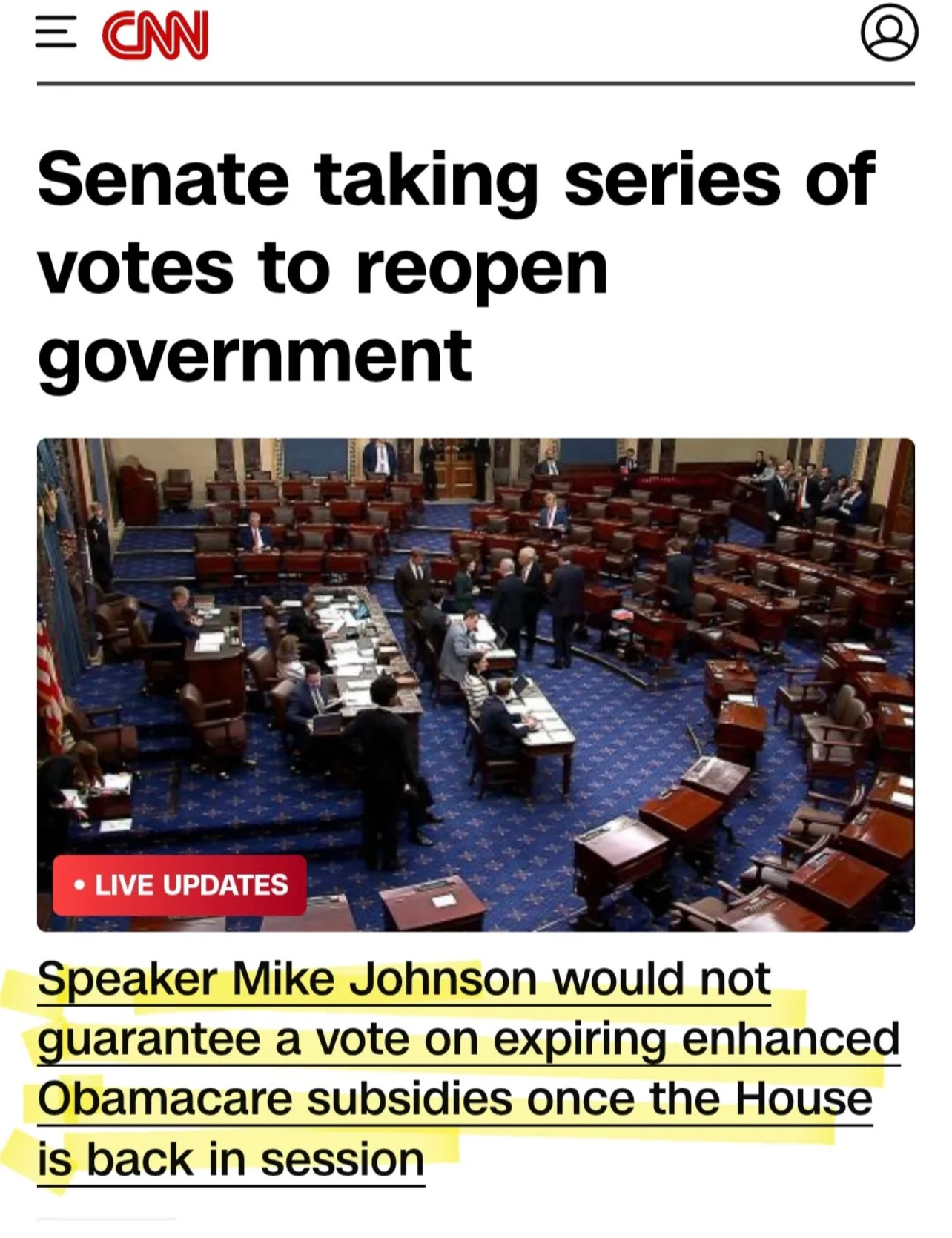
Who could have seen this coming?
The House is expected to vote on the budget deal at 4 p.m. ET today.
It would then go to Trump’s desk. It’s unclear when he plans to sign it. But when he does, it’s likely federal employees would be called back to work by the next morning or within hours.
Meanwhile, Speaker Mike Johnson says he’ll finally seat Representative-elect Adelita Grijalva of Arizona, who has been waiting to be sworn in for 7 weeks. Johnson has delayed seating her in an attempt to avoid releasing the Epstein files and to avoid seeing his party’s margin of control shrink even further. There is no rule against Johnson seating her. He could have done so within days of her election — even when the government was shut down or the House was in recess. He’s done that for newly elected Republicans multiple times.
Grijalva will be the last required signature on a petition to force a vote to release the Epstein files.
Trump publicly confirmed in the Epstein files
While not directly about the shutdown, it needs to be noted that the first public confirmation that Trump is in the Epstein files happened on what could potentially be the last day of the shutdown.
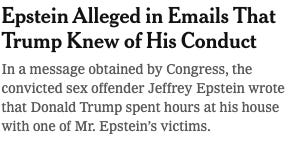
NYTimes Headline
It’s rare that a conspiracy theory turns out to be… well, not a theory at all. But very real and exactly what we expected it to be.
In this email alone, you can see the blackmail in real time:
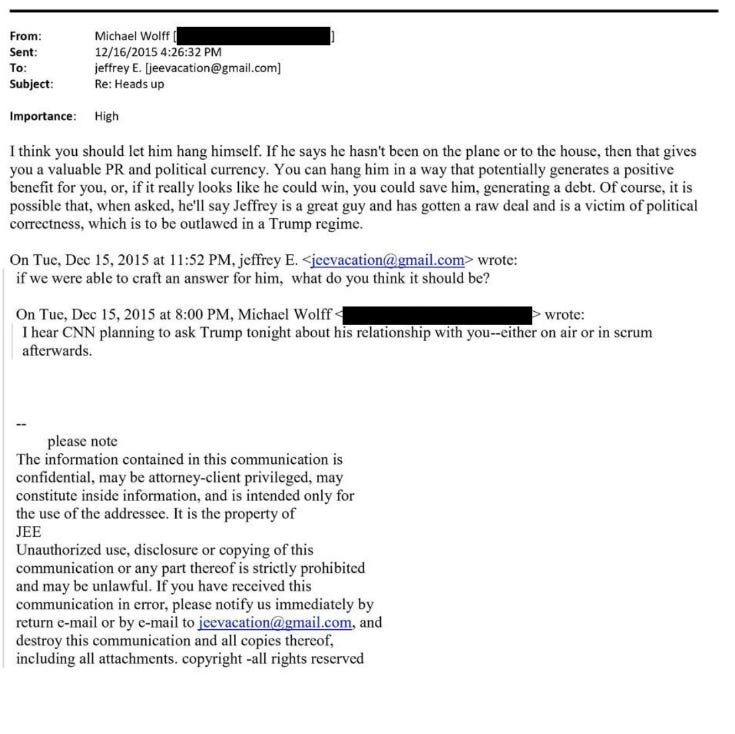
Highlights:
“if we were able to craft an answer for [Trump], what do you think it should be?” — from Epstein to Michael Wolff, his biographer.
“If [Trump] says he hasn’t been on the plane or to the house, then that gives you a valuable PR and political currency… if it really looks like he could win, you could save him, generating a debt.” Michael Wolf to Epstein.
To a certain extent, this shutdown has also been about the Epstein files. A decent argument could be made that from Trump’s perspective, it was all about the Epstein files. It offered a huge distraction, and Johnson used it as a reason to keep the House out of session to avoid a vote on the Epstein files. This is the second time he’s done that.


Day 42: SNAP benefits still have not been paid.
A shutdown deal is in the works; multiple courts have said the Trump Administration must pay SNAP benefits—food—to people, and that has still not happened.
“Nothing is preventing the Trump administration from fully funding SNAP benefits. They are simply choosing not to. The fastest way to clean up this mess would be for the federal government to drop its court appeals.” — In a press release from Gov. Jared Polis’s office, similar to numerous statements across the country.
Meanwhile, it’s unclear when flights will return to normal. Duffy threatened Congress — notably his own Republicans — to pass the budget deal or face worse flight cuts.
DAY 41: This isn’t over
UPDATE: The Senate passed the package on the expected 60-40 vote, with the 8 Democratic defectors voting for and GOP Sen. Rand Paul voting against.
Sen. Baldwin’s amendment to extend Obamacare subsidies for one year failed 43-57 on a party-line vote.
Sen. Rand Paul’s amendment to strip a hemp provision he said would harm hemp farmers failed 24-76.
Oregon Sen. Jeff Merkley’s amendment to protect Congress’s power of the purse and push back against Trump’s funding recessions failed 43-57 on a party-line vote.
“None of us are well served by a situation where the president decides to cancel programs based on the president’s preferences. That’s not a democracy.” — Sen. Jeff Merkley of Oregon.
UPDATE: The Senate will vote on the package Monday night, meaning a vote in the House would come as early as Wednesday morning.
Additionally, Sen. Tammy Baldwin of Wisconsin has inserted an amendment on extending the ACA tax subsidies for one year.
Wednesday is likely earliest we’ll see a vote in the House to reopen the government.
This means Sunday’s court ruling that SNAP payments must be paid out in full (and another court ruling that the Trump administration cannot punish states who tried to get money out over the weekend) is important for families that can’t wait another three days.
Meanwhile, it will take months for some federal workers to be made whole once the government reopens. Last shutdown, it took 2.5 months for some air traffic controllers. If that’s the case again, we could be preparing for the next shutdown by the time they are fully paid back.
Republicans will take any hostage: federal workers, democracy, healthcare... kids

Eight Senate Democrats defected from the party Sunday to strike a deal to end the shutdown. We’ve been following the shutdown for 40 days. Here are three thoughts as we head into the final hours.
Trump and Duffy were about to take Thanksgiving hostage
Food banks across the country have had to increase the number of food boxes they are planning to hand out for Thanksgiving. And still, they’ve had to turn people away.
The Trump Administration continued to fight tooth and nail to block funding for SNAP, for food, during the shutdown.
They were even willing to so ahead of a holiday that celebrates charity, community, and gratitude—a holiday where the founding mythology revolves around one group of people feeding another group of people in need.
The metaphor, the irony, is too spot-on.
Meanwhile, Sect. of Transportation Sean Duffy threatened to reduce travel “to a trickle” on Thanksgiving and said people would not see their families.
Duffy declared that 4% of flights would be cut this weekend. That equalled more than 1,500 flights cancelled on Sunday and another 4,200 delayed. That would increase to 6% on Tuesday, 8% on Thursday, and 10% by this coming weekend. And much worse by Thanksgiving week.
He claimed this was to relieve air traffic controllers; it’s wasn’t. Duffy had already threatened to fire controllers who called in sick; he’d done nothing to relieve their pain; and his strategy to cut more and more flights as we approached Thanksgiving was nothing more than political theatre and cruelty.
Typically, the White House tries to help Thanksgiving travel (the busiest of the year) by opening up military air routes or boosting resources at airports. Not this White House. No, this White House doesn’t think we—the peasants—deserve Thanksgiving.
Not to mention the toll limited holiday travel would have on the U.S. economy—an economy on the brink of collapse for many people.
Day 40: UPDATE: The senate has struck a deal
A handful of Senate Democrats have defected from party leadership to cut a deal with Republicans.
The defectors include: Sen. Tim Kaine of Virginia, Ind. Sen. Angus King, Sen. Jeanne Shaheen of New Hampshire, Sen. Maggie Hassan of New Hampshire, Sen. Catherine Cortez Masto of Nevada, Sen. Dick Durbin of Illinois (the #2 Democrat in the chamber), Sen. Jacklyn Sheryl Rosen of Nevada, Sen. John Fetterman of PA. That’s the 8 needed.
In past votes, Sen. Ben Ray Lujan of New Mexico voted yes, and GOP Sen. Rand Paul voted no. It’s unclear how they’ve voted.
To be clear, reopening the government will still take time. Whatever the Senate passes tonight will require the House to reconvene; they have been out of town for months. Getting the deal to the White House might take a day or two.
“I cannot support a deal that still leaves millions of Americans wondering how they are going to pay for their health care or whether they will be able to afford to get sick,” — Sen. Mark Warner of Virginia, Sen. Kaine’s counterpart in the state.
Here’s what the deal does not include:
An extension of Affordable Care Act subsidies; the whole purpose for this shutdown fight. Senate Republicans gave Democratic defectors a promise to vote on ACA subsidies. That’s it.
Majority Leader Thune says that vote will come no later than the second week of December, but didn’t say what type of bill would be voted on. It’s also not clear if that promise includes a vote in the House.
Democrats had for weeks said they would reopen the government if the ACA subsidies were made permanent. This week they compromised and said they’d be willing to strike a deal with Republicans on a year-long extension. But the GOP said no.
Now the defectors have struck a deal for nothing on healthcare.
“It’s a mistake,” Sen. Elizabeth Warren of Massachusetts.
Here’s what the deal includes:
The deal will reverse layoffs that occurred during the shutdown. Even though those layoffs were illegal to begin with…
A stopgap measure to open the government through Jan. 30.
Three bills that cover agriculture, military, and legislative agencies.
From earlier today: The deal involves 3 of the 12 bills required to fully fund the government: one for military construction and the VA, a second for the FDA and Dept. of Agriculture (which runs SNAP), and one for the legislative branch. But it’s not clear what’s in those bills. The continuing resolution to reopen the government would come along.
$1.2 billion for the Food for Peace program that buys extra food from farmers and sends it to countries with famine. Trump had cut the program, but Republicans in rural farm communities had pushed to return it.
It ends an attempt to weaken the Government Accountability Office, which has twice ruled that Trump’s withholding of federal funds was illegal.
A year of funding for SNAP and WIC—the Women, Infants, and Children WIC Program that helps with nutrition and healthy foods.
“It would be a policy and political disaster for Democrats to cave,” Bernie Sanders of Vermont.
Democrats—from moderates to progressives—were unhappy, including Sen. Bernie Sanders of Vermont (a Democratic Socialist) and Sen. Elissa Slotkin of Michigan (a moderate).
“I always said we’ve got to do something concrete on health care, and it’s hard to see how that happened,” Sen. Slotkin told the NYTimes.
Senate Minority Leader Chuck Schumer voted no. Meanwhile, House Minority Leader Hakeem Jeffries was a hard no and said House Democrats would not support the deal, but House Republicans do not need any Democratic votes to pass whatever bills the Senate sends them.
“I don’t think that the House Democratic Caucus is prepared to support a promise, a wing and a prayer, from folks who have been devastating the health care of the American people for years.” — Rep. Jeffries.
Senate to meet Sunday
In a rare weekend session, senators are discussing a possible deal today, though no votes have been scheduled. It could involve a partial funding deal that would reopen the government into January (though a date has not been settled on) as well as fund programs like SNAP for a full year. The deal involves 3 of the 12 bills required to fully fund the government: one for military construction and the VA, a second for the FDA and Dept. of Agriculture (which runs SNAP), and one for the legislative branch. But it’s not clear what’s in those bills. The continuing resolution to reopen the government would come along.
But it’s unclear what concessions have been made to ensure health care premiums don’t explode for 20 million Americans and that an additional 20 million Americans don’t lose access to Medicaid or local clinics.
Additionally, this would require Speaker Mike Johnson to bring the House back in session. And any deal in the Senate would have to survive the House.
Trump’s Policy of Starvation
The Trump Administration is telling states to “undo” any steps they’ve taken to get SNAP benefits to hungry people. The USDA is threatening to penalize states that don’t do so quickly.
Setting the inhumanity and cruelty of this aside—which is a big aside. I am baffled by this politically and electorally. How do Republicans see being pro-starvation as a winning policy? It would make far more sense for Trump to cosplay a hero by “solving” a crisis he created and demand checks be sent out directly to voters—with his signature attached in big font.
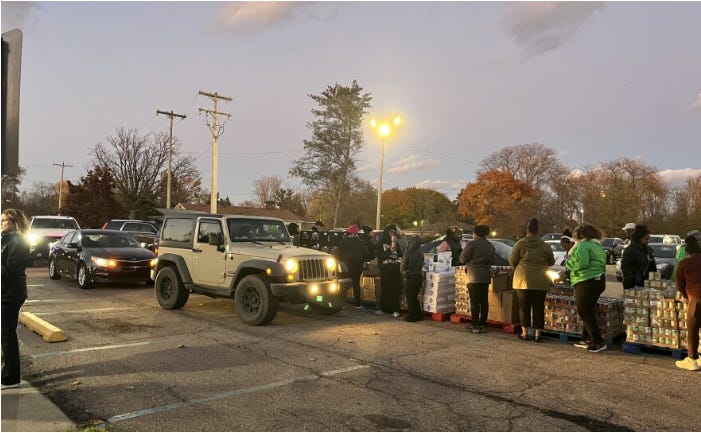
The Tabernacle of David Church has a monthly food drive. They’ve seen demand double. Source: WKAR Public Media, Michigan.
But to insist people not be able to eat, many of them kids, the elderly, and your own voters, in order to cut healthcare for kids, the elderly, and your own voters... is baffling. These tactics only make sense if your end game is to suspend elections and take authoritarian control. This cruelty only makes sense if you believe there are no electoral consequences for your actions.
Day 39: The Hoovervilles of 2025
During the Great Depression, slums formed across the country, from New York City to Seattle, after the U.S. economy collapsed. They were named Hoovervilles after then-President Herbert Hoover.
These shanty towns lasted years and grew to thousands of people—including a 15,000-person Hooverville in Washington, DC, dubbed “The Bonus Army” because it was made up of WWI veterans demanding relief. The largest recorded Hooverville was in St. Louis; it was so big it had four districts. NYC’s Central Park had one. Seattle had as many as eight, one with a semi-functioning government and mayor.
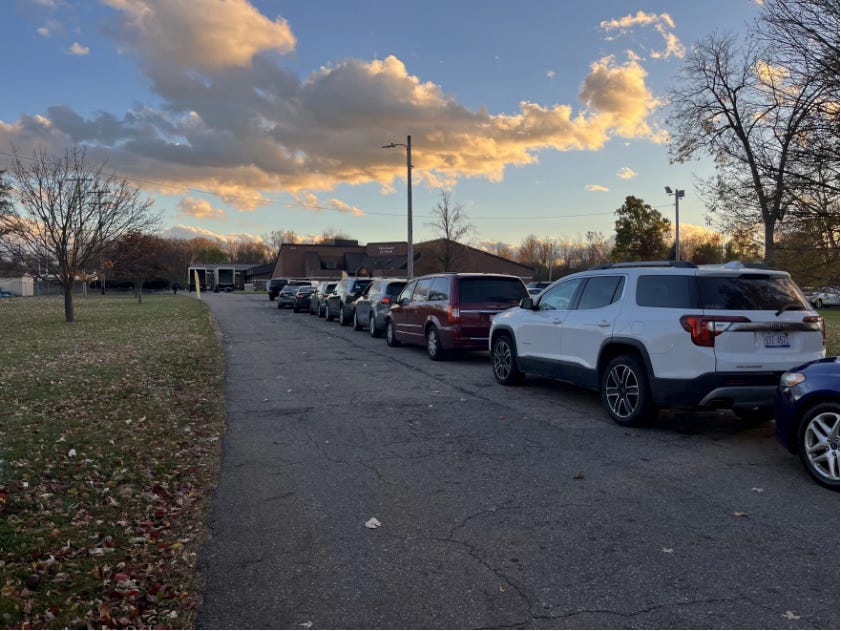
The Tabernacle of David Church has a monthly food drive. They’ve seen demand double. Source: WKAR Public Media, Michigan.
Are we seeing the opening frames of that world? We are in the middle of a housing crisis, a homelessness crisis, an affordability crisis, added inflation, added high food prices, a healthcare crisis that’s about to explode… the list goes on.
Now 42 million people have been cut off from basic food—most of them kids, the elderly, single moms, the disabled.
42 million people.
Food banks are overrun and under-resourced. Many pantries across the country are spending 3 times as much per week and still falling short of demand. They’ve had to limit requests for holiday food boxes already. They are having to turn people away. We are seeing photos and videos of lines out the door at kitchens and food banks, lines of cars in parking lots of churches and community centers waiting for a box of food.
The scale of this crisis is hard to describe because of its size. The numbers are dizzying. In Colorado, 600,000 people are on SNAP—half are kids. Meanwhile, 425,000 people rely on SNAP in Houston alone. Second Harvest of Silicon Valley saw requests increase by 200%. States like Colorado and Louisiana are giving emergency funds to help food banks, but with cuts to SNAP by Republicans earlier this year, it’s just not enough.
Leaders of food banks across the country have likened this to a natural disaster; except this is man made, and it’s everywhere.
For every meal that food banks provide, SNAP provides nine, creating an even larger chasm of need for banks to fill. — Jon Toups, CEO of Second Harvest Food Bank of South Louisiana.
Meanwhile, the food crisis is exacerbated in food deserts where there is no access to a grocery store—similar to the healthcare crisis where clinics and hospitals are shutting down in rural and impoverished areas.

People line up for food at The Church of Jesus Christ of Latter-day Saints ward parking lot in the Rose Park area in Salt Lake City. Source: KUTV Salt Lake City.
📰 Still ‘just at the beginning’ of crisis via CNBC
📰 Mosque in Aurora raises money for Colorado food bank via CBS Colorado
📰 Food banks face a ‘perfect storm’ via CBS Milwaukee
Day 38: Trump stops SNAP again
After a court ruled that the USDA must fully pay out SNAP benefits—not 50% or 65%, but 100%—many states began moving quickly to pay their citizens, including New Jersey, Pennsylvania, Wisconsin, and Colorado. A notice went out in some states saying people would see money in their SNAP accounts by Saturday. This is food that’s desperately needed, and many of these states knew that residents couldn’t wait any longer and tried to take advantage of the open window.
But the Trump Administration appealed the ruling (again), and SCOTUS stayed that ruling until an appeals court could hear the case—meaning SNAP funds were frozen again until the court could go through their process. The Trump Administration closed the window within hours.
People are starving while the Trump Administration plays legal games and hosts extravagant parties. To be clear, there’s a political system where this is normal: oligarchy.
Day 37: 40 airports targeted for cuts
On Wednesday, the FAA said it could cut down traffic by 10% at 40 locations. On Thursday the AP was able to obtain a list that included major hubs.
“The affected airports covering more than two dozen states include the busiest ones across the U.S. — including Atlanta, Denver, Dallas, Orlando, Miami, and San Francisco. In some of the biggest cities — such as New York, Houston and Chicago — multiple airports will be affected.” Source: AP.
Thousands of flights could be cancelled, and airlines are already beginning to inform travelers. Experts have warned you can’t shut down some airspace without it affecting the whole country.
This week, lines at Dallas-Fort Worth International Airport stretched 4+ hours to get through TSA. Meanwhile, air traffic controllers have had to delay flights due to staffing shortages.
At least one airport is getting creative and trying to avoid the mess. Denver International Airport has asked Washington for permission to pay their air traffic controllers out of their own budget for now. Denver is a crucial hub for travelers getting across the country and the third busiest airport in the U.S.
FAA controllers have now been working more than a month without getting paid. Many are overworked, stressed, calling in sick, and unsure how to make ends meet. Staffing shortages across the country are adding up and compromising air safety.
Air traffic controllers have historically held a lot of leverage in government shutdowns. Trump’s last shutdown in 2019 ended because controllers were calling in sick, and that pressure built up until the White House buckled to then-Speaker Pelosi.
Trump calls to end the filibuster
The president is demanding Republican senators end the filibuster, calling them stupid for not doing so.
Trump would ironically be doing progressives a favor in the long run and checking off a long-held wish. Democrats would no longer need to debate removing the filibuster and could return to power with the ability to deliver mass reforms voters have been demanding for decades—healthcare, regulating Wall Street, fighting the housing and affordability crisis, the list is long.
Senate Republicans understand this, and Majority Leader Thune has said nuking the filibuster isn’t going to happen. In a rare display, Trump backed off, saying he wasn’t willing to risk his relationships with senators that voted against impeachment last time around.
“Do I want to lose my relationship with those Republicans that have been very good to me for a long period of time, that voted against the crooked Democrats on impeachment and everything else?” Trump said.
I find it interesting that he’s backed off here and flat out brought up impeachment. I wonder if the Epstein Files and more impeachment trials are on his mind.
Though let’s be clear, the loss of the filibuster right now runs the risk of causing more dramatic and traumatic harm for the next year. It’s the only mechanism Democrats have to slow Trump. While the GOP and MAGA are already running the government with impunity and ignoring Congress, losing the filibuster in this moment would further consolidate power. There’s no doubt the GOP would end Obamacare, privatize Social Security, slash Medicaid, and continue a march towards dismantling the federal government that would make DOGE seem quaint.
Day 36: A New Record
This is officially the longest shutdown in U.S. history.
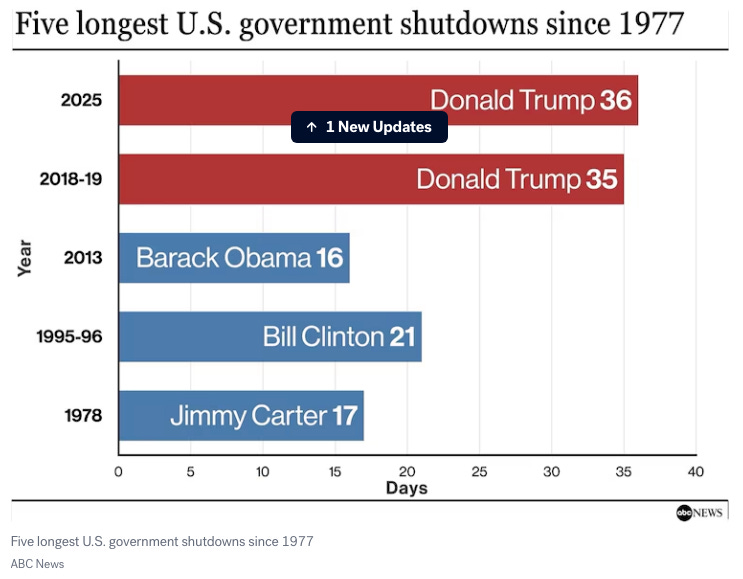
If you wonder how we got here: It’s because Trump does not care. His leadership is vapid, and it’s all just a game to him.
Kids starving? A game.
Grandma losing her healthcare? A game.
Dad out of a job? A game.
Single mother losing childcare? A game.
Farmer facing bankruptcy? A game.
Trump and MAGA and the Republican Party do not care about normal people; they do not care about maintaining a functioning economy and democracy; they do not care about you.
Trump has now presided over the two longest shutdowns in human history—and the largest pandemic in 100 years and some of the largest economic crashes in U.S. history and the storming of the U.S. Capitol and and and… the list goes on. That’s not an accident. That’s not ‘bad luck.’
Leadership matters. Who we elect matters. Democracy is about making choices, and those choices have consequences.
Election Fallout: Republicans are losing the shutdown fight
Yesterday, I said Tuesday’s election was a referendum on both Trump and the shutdown. Voters gave Democrats resounding wins just as the shutdown impacts are ramping up and affecting people’s lives. The message could not be more clear and… Trump agreed.
“I think if you read the pollsters, the shutdown was a big factor, negative, for the Republicans,” the president told the press.
Day 35: Election Day
Update: The Senate failed to pass the budget C.R. for the 14th time Tuesday. No senators have changed their position, with Republican Rand Paul voting with Democrats to oppose the bill. Independent Sen. Angus King and Democratic Sens. Cortez Masto and Fetterman voted with Republicans to pass the C.R.
Update: Trump says let 42 million people starve
Trump is once again stopping SNAP payments from going out to 42 million Americans. This, a day after his own Dept. of Agriculture said they’d give out at least partial payments to families in need. Trump wrote on Truth Social that people would only be allowed to eat “when the Radical Left Democrats open up government, which they can easily do, and not before!”
Update: Trump admin Duffy threatens “mass chaos” and to close airspace “in certain areas”
About half of air-traffic control locations are working with staffing shortages. While controllers are required to work without pay during the shutdown, many are calling in sick.
Airports are where we see the results of shutdown most quickly. Long TSA lines and flight delays are a tangible (and social media friendly) result of a closed government, particularly around the holidays.
The last shutdown ended because air traffic controllers continued to call out of work, putting pressure on Trump to compromise with Speaker Nancy Pelosi. It appears those workers understand their leverage and are doing the same this time around.
“You will see mass chaos,” Transportation Secretary Sean Duffy said. “You will see mass flight delays. You’ll see mass cancelations, and you may see us close certain parts of the airspace, because we just cannot manage it because we don’t have the air traffic controllers.”
The “certain parts of the airspace” seemed to be a not-so-veiled threat that Democratic cities and areas of the country would be targeted—though he did not specify where.
Election Analysis
In another example of reality being stranger than fiction, election day also marks a record for the shutdown. It has now been 35 days, tying the record for the longest shutdown in U.S. history. The other was from 2018-2019 under the last Trump Administration.
Make no mistake, Trump announcing on election day that SNAP payments won’t go out is not an accident. Transportation Sect. Sean Duffy threatening on election “mass chaos,” “mass cancelations,” and the closing of “certain parts of the airspace” is not an accident.
They think by applying more pressure today, when people are headed to the polls, that it’ll push Democrats to buckle tomorrow.
This is just a game to them.
Today will be the biggest data point from the U.S. electorate since the 2024 presidential election. This will not only be a referendum on Trump (ICE, tariffs, inflation, the list goes on), but also on the government shutdown. This comes just as SNAP benefits have been cut in half, as federal workers missed their first full paycheck, and as Americans receive notices about their health care premiums for next year.
Here are the key races I’m looking at:
California Prop 50: Gerrymandering.
If this prop passes (and if it passes handily), this will be a clear indicator that voters are finally getting what they want out of the Democratic Party—a fight. It will signal to Democrats around the country that to win this moment in history is not to sit on your hands and pray for things to blow over. Get your ass up and fight fascism with every tool available to preserve our democracy.Virginia Governor’s Race
The race has often, particularly recently, indicated where voters are headed for the upcoming Midterms. The race always comes up the November after a presidential election, giving voters an opportunity for a referendum on the sitting administration. While Virginia has become reliably Democratic since Obama’s 08 campaign, it’s purple for statewide races like senate or governor. This will be a close contest.New Jersey Governor’s Race
Usually this race wouldn’t indicate much. For context, Biden and Clinton won Jersey by 16 pts in 2020, Clinton by 14 pts in 2016, and Obama by 17 in 2012. But Harris only won by 6 pts after Trump made dramatic gains in the state last year. Was this just an outlier in one of the strangest presidential elections in American history or a harbinger for a conservative swing in the state? A Quinnipiac poll had Democratic nominee Rep. Mikie Sherrill up by only 8 pts. We’ll see what the final result might indicate.
“This is a New Jersey election, but it’s also a national election,” Sen. Corey Booker
Pennsylvania Judges:
Voters in PA are voting on retaining judges on their State Supreme Court. There’s no challengers in the race, it’s a binary choice to either keep the judge or call for an election for that justice’s seat. By chance, the judges up this cycle are liberal leaning. While this race won’t garner to much national attention, it’s worth watching in a swing state that continues to come down to the margins.
Day 34: $4.6 billion for SNAP
The USDA said it will make about half the needed payments for SNAP benefits to go out to the 42 million people—families, children, and elders—that rely on the program to eat.
We need to be clear on something here: The Trump Administration could have sent out these payments all along. They are now being forced to do so by a federal judge who demanded a plan be presented to him by today. And still, there is more emergency funding they are refusing to use, and they are dragging their feet, saying payments may not go out for weeks or months.
If Trump has proven anything, it’s that he’ll do whatever he wants with the federal government’s money—with or without congressional approval or oversight. He is choosing to let people starve.
Meanwhile, he hosted a 1920s-styled party at Mar-a-Lago over the weekend—with exotic dancing, flappers, champagne, and gold-gilded everything to boot. It’s just the latest and most bizarre “Let them eat cake” moment of the Trump administration—and there have been many. If you were to write this as a Hollywood script, producers would tell you it’s hyperbolic and too on the nose.
Speaker of the House Mike Johnson admits he’s starving people in order to pressure Democrats
Day 33: Halloween as SNAP benefit replacement
Families on Halloween are trick-or-treating longer as a means of collecting food—candies and snacks—to help supplement their meals.
That is a real-life Halloween nightmare. Additionally, ICE continued operations during the holiday (against a direct request from Gov. Pritzker). They chased teenagers in the dark; they forced Halloween parades to cancel; they terrorized Chicago.
Oct. 31, 2025, might go down as the worst Halloween in American history. Meanwhile, we are starving families in the run-up to Thanksgiving.
“Days just got burned, where the president didn’t care. He wasn’t thinking about it… Because to him this was a video game.” — Miles Taylor, Former Trump Administration DHS Chief of Staff.
Day 32: Trump withholding SNAP benefits is illegal
Congressman Joe Neguse of Colorado.
Day 31: The court ordered Trump to pay out SNAP benefits. He’s finding excuses not to
SNAP benefits will freeze Saturday despite a court ordering the Trump Administration to continue SNAP funding.
The program helps to feed 42 million people at the cost of about $8.6 billion per month. The USDA, which runs the program, has an emergency SNAP fund that currently holds between $5 billion and $6 billion—not enough to fund the whole program, but more than enough to help those in the most need.
Rhode Island Judge John McConnell called Trump’s decision to not pay SNAP benefits arbitrary and capricious. “There has been no explanation, legitimate or otherwise, that’s consistent with the APA as to why the contingency funds should not be used.” He gave the Trump Administration a Monday deadline to show how they will make the payments.
“There is no doubt, and it is beyond argument, that irreparable harm will begin to occur—if it hasn’t already occurred—in the terror it has caused some people about the availability of funding for food for their family,” Judge McConnell said.
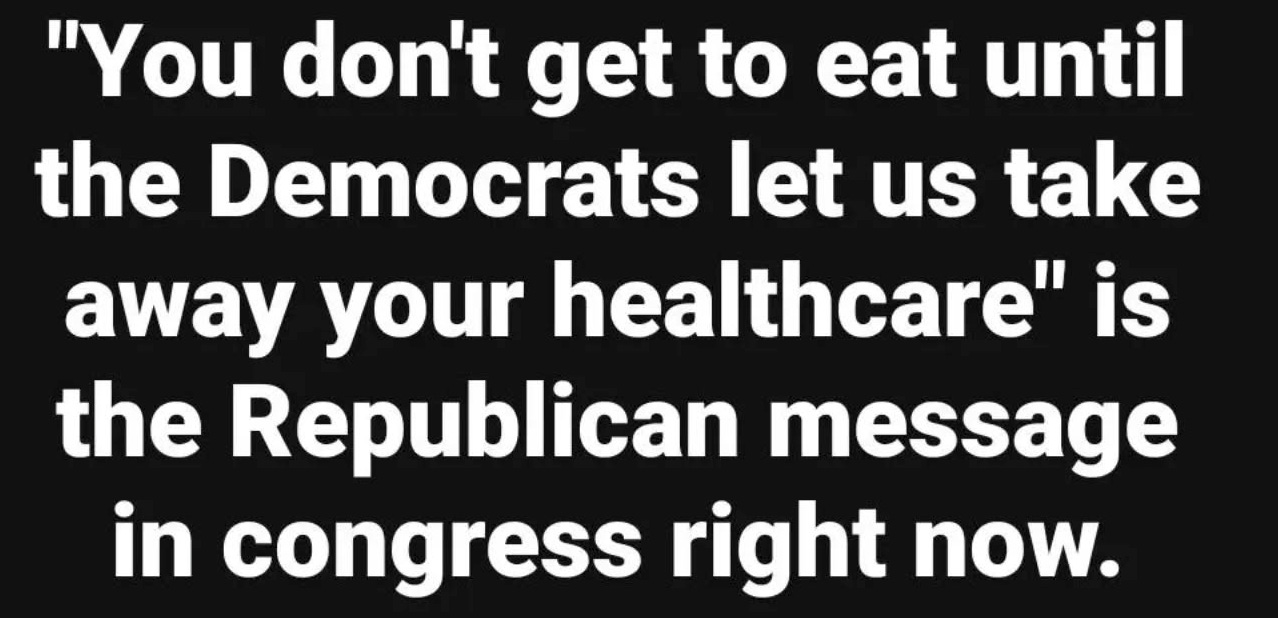
“Republicans would rather take food out of the mouths of babies, so they can give a tax cut to the richest people in our country,” Rep. Nancy Pelosi.
Day 30: A reminder of what we are fighting for
The Affordable Care Act/Obamacare expanded health insurance coverage by 38+ million people in the first ten years of the program.
This is the work we are fighting to defend in this shutdown.
The ACA cut the U.S. uninsured rate in half, from 14.4% to 7.9%, the lowest in American history.
In 2025, more than 44 million people were insured under Obamacare—either through the ACA marketplaces or Medicaid expansion.
While there is still a lot more work to do in getting affordable, quality healthcare to all Americans, the ACA was a huge step toward that goal.
We outlawed “preexisting conditions.”
It banned annual and lifetime coverage caps.
It banned insurers from dropping people when they got sick.
It created a maximum annual out-of-pocket cap. Meaning, people would only be forced to pay a certain amount before insurance had to cover the rest.
Preventative care, vaccines, and medical screens could not be subjected to co-payments, deductibles, or co-insurance.
Young people were allowed to stay on their parent’s health insurance until they turned 26.
States had to provide health insurance to children whose families did not have coverage.
It expanded women’s health coverage.
We take these things for granted now because they feel like common sense. But those common sense policies took decades to win.
We can’t go backwards.
This is what presidential leadership looks like: fighting to help millions of people.
The moment 21+ million people gained healthcare from the ACA’s Medicaid expansions. Ten years later, Obamacare had expanded the insured population by 38+ million people.
Day 29: The lies continue but the truth stays the same
Day 28: Snap benefits will end Nov. 1 for 42 million people
“It’s not a privilege to have food, it’s a human right to have food.” — Gov. Tim Walz.
SNAP still has funding—Not enough for full services, but enough to help families most in need.
“Nearly two-thirds of the funds needed for a full month of benefits are available in SNAP’s contingency fund and must be used when regular funding for SNAP runs short,” wrote The Center on Budget and Policy Priorities. “The Administration must release those funds immediately as SNAP law requires, to ensure that families can put food on the table next month.”
SNAP needs about $8 billion to feed the 1 in 8 Americans on food stamps. The contingency fund totals just under $6 billion, according to NPR. At least $5 billion is available to provide partial relief to people, according to the Center. But Republicans are refusing to use that money in an effort to punish Democrats.
On top of that, the Trump Administration is once again flaunting the Hatch Act, with a banner on the USDA website blaming Democrats for the shortage and claiming the shutdown is about “healthcare for illegal aliens and gender mutilation procedures.”
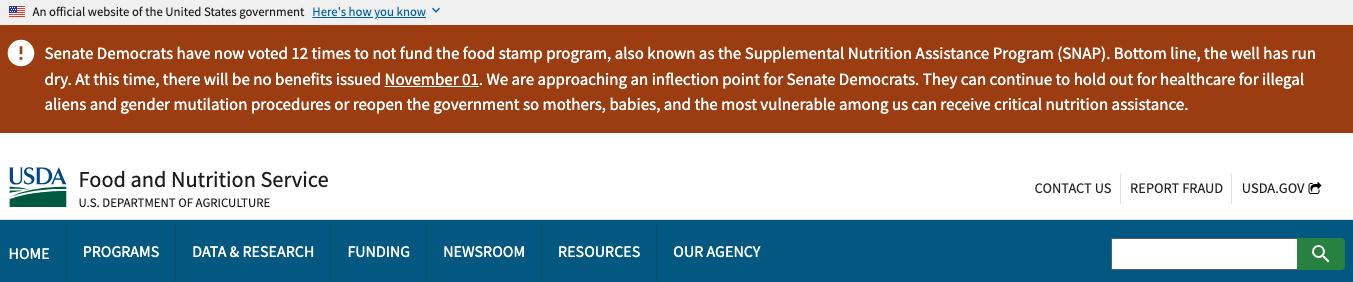
On Tuesday, two dozen attorneys general from Democratic states sued the Trump Administration for refusing to pay SNAP benefits during the shutdown.
Day 27: $40 Billion to Argentina for election interference
Trump has promised right-wing Pres. Javier Milei and Argentina a bunch of money to prop up the peso ahead of Sunday’s midterm elections in that country—$20 billion from the federal government and another $20 billion from private sources. It’s a currency swap. The Argentine government gets to prop up its peso, and the U.S. government gets a bunch of pesos it doesn’t need.
Why? Because the peso is faltering. It’s already overvalued, and markets don’t believe that overvalue is sustainable. Meaning, the peso’s value could fall further, causing inflation. Which is not something you want looming during a midterm election.
And Trump is not so much propping up the peso as he is propping up his right-wing buddy. Milei is a self-described anarcho-capitalist, a fringe branch of libertarianism that calls for the abolition of the state and the privatization of all government provisions. He campaigned on attacking the elite, institutions, and slashing bureaucracy. (Sound familiar?) But since coming into power, people have accused him of abandoning the working class that got him elected, and his administration has been ridden with bribery scandals and grift. (Truly birds of a feather.)
But here’s the kicker: Trump indicated that the $40 billion was dependent on the election outcome. Meaning, he’s willing to spend American taxpayer money to bribe Argentinians to vote for his friend and dangle their economic future in front of them.
All this while the U.S. government is shut down: 1.4 million federal workers are not getting paid, SNAP benefits are about to expire for 40 million hungry people, and 20 million people are about to lose Medicaid.
But hey, what’s $40 billion to buy your friend’s election? It worked.
Milei’s party won handily. Early results show his party won 64 seats (out of 257) in the House of Deputies, up from their current 37. It’s too early to know the results in the Senate. The opposition still holds the most seats in both chambers, but the result will allow his party to enact his agenda and protect his vetoes through alliances with other parties.
(Total side note: The U.S. should hold elections on Sunday.)
Day 26: $130 million
That’s how much an anonymous Republican donor gave the Pentagon to help pay military members during the government shutdown. The number sounds grand and made plenty of weekend headlines. However, the donation averages out to about $100 a person, far short of a real paycheck.
Let’s make something very clear: The donor—reported to be Timothy Mellon, a reclusive billionaire and heir to the Mellon fortune—might have had the best of intentions in mind. But for ‘Trump the Conman,’ this is a $120 million ad. It creates headlines to make MAGA Republicans look like they care but has all the practicality of “let them eat cake.”
Meanwhile, Senate Democrats introduced proposals to pay every federal worker during the shutdown. Republicans didn’t even allow those bills a vote. The GOP voted on a bill to pay military and essential workers. Democrats—smartly—blocked that bill. That type of proposal is exactly how we end up with a government that never reopens and the Trump administration paying only the workers they deem worthy.
Day 25: $23,700 per year
That’s how much more a 60-year-old couple in Kentucky making $85,000 combined per year would have to pay for health insurance under the current Republican plan.
This is what Democrats have been yelling about.
The health insurance open enrollment window begins at the end of the week, Nov. 1. This is when healthcare advocates expect voters to receive “sticker shock” as they look at their new health insurance costs for 2026. But a dozen states made their prices available this week. Another 28 states will release their estimates next week.
Here are some of the shocking numbers:
In Nevada, an older couple making about $85,000 combined could pay $18,100 more.
In Minnesota, the cost for a similar couple might be $15,500 more.
In Maryland, it could be $13,700 more.
In Maine, a family of four making $130,000 combined would face an increase of $16,100 in annual premiums next year.
Interestingly enough, Healthcare.gov usually publishes these prices ahead of the enrollment window; they haven’t this year.
Overall, health insurance prices are set to rise 18% nationwide. However, people whose plans included an Obamacare subsidy and people who are about to be kicked off Medicaid will be hit much, much, much harder. And most of those people are in states Trump won in 2024.
Day 24: A Big Shutdown deadline is now looming
Here’s a kicker, Nov. 21st: The House-passed budget bill was only slated to run until Nov. 21st. The House will have to return to pass a new C.R. because the bill in the Senate — the one they keep voting on over and over and over again — will be worthless. This means Speaker Mike Johnson’s excuse to keep the House out of session and on vacation will expire. (I’m interested to see how he talks himself out of that one.) A new House session puts a few items into play.
Arizona Representative-Elect Adelita Grijalva has still not been sworn in after winning a special election on Sept. 23rd. Johnson has used the shutdown as an excuse to continue delaying swearing her in; even though she was elected 10 days before the shutdown. Johnson has sworn in Republicans who’ve won special elections within 48 hours of their victories.
House budget negotiations: Any new C.R. would likely include new negotiations over health care premiums. The House was able to get around those last time without Democrats. But now Republicans, like Rep. Marjory Taylor Greene, are breaking with the party. This could get interesting. Remember, the GOP only has a 3-seat majority. Any minor defection would mean Johnson would be forced to negotiate. Would Democrats be invited into that negotiation? Could a bipartisan coalition of populist House members form? It would only take a few to completely change the direction of the negotiations.
Senate budget negotiations: Seeing the horizon up ahead, Republicans are looking to create a new C.R. that would run from mid-December through perhaps early spring of 2026, with a potential vote on insurance premiums tied with it. If this is true and does not come with any legislative tricks, then Democrats are nearing a huge win in the shutdown fight.
Trust will be a big factor in any deal. Democrats have no reason to trust Congressional Republicans or the White House. They shouldn’t. Any deal would have to be legally bound—not based on norms or a handshake deal.The Epstein Files: Yes. Those. Representative-elect Grijalva has vowed to sign a bipartisan petition to force a vote to release the Epstein files. And—in a twist of fate that proves reality is stranger than fiction—Grajalva would be the decisive 228th signature that would trigger the vote. (Not even Hollywood can make this stuff up.) Republicans and Democrats are accusing Johnson of keeping the House in recess in order to avoid swearing her in and avoid the vote. This is the second time he has kept the House out of town in order to avoid an Epstein Files vote.
Day 23: No paycheck on Friday & Other Payday Deadlines
This Friday, Oct. 24, will be the first major paycheck absence in the shutdown.
Two weeks ago, federal workers received their last pay stub. It was a partial one, covering the last pay period before the shutdown—minus the few days that fell after the budget deadline.
Then, last Wednesday, Oct. 15th, the Pentagon shifted money around to make sure military employees received payment.
Friday will be the first time all employees due a paycheck won’t receive anything.
On Wednesday, the Senate again failed to pass the GOP spending measure. And Republicans wouldn’t even allow the Democratic spending measure to receive a vote.
Additionally, a measure by Democrats to pay all federal employees (including military members) was not allowed to receive a vote. Meanwhile, Republicans tried to pass a measure to pay only military members. That did not pass.
The next major deadlines?
Halloween, Oct. 31st: That’s the next payday for military members who receive an end-of-the-month paystub. It’s unclear if the Pentagon will attempt to move money around again—or if they can.
Then comes Nov. 1st: People are expected to start receiving health insurance premium increase notices in the mail. This is when warnings by Democrats will start to become reality as voters receive sticker shock in the mail. Some people might see their premiums double, triple, even quadruple.
Day 22: The 2nd longest shutdown in history
Today makes it official, this shutdown has now passed the Clinton vs. Gingrich shutdown from Dec. 1995 to Jan. 1996. That shutdown had to do with Medicare premiums, along with the environment and education.
As much as things change, they stay the same.
Our current shutdown is second only to Trump’s last shutdown, the record holder: 35 days, from Dec. 2018 to Jan. 2019. That had to do with funding for Trump’s border wall. He never got it.
ICE Arms
Though technically not shutdown news, this was the biggest headline of the day.
ICE — Trump’s masked militia — has increased spending for weapons by 700%, according to a report from independent journalist Judd Legum (a fellow substacker). Those purchases include “guided missile warheads and explosive components.”
In the 2010s we asked why police were buying tanks. Why is ICE buying missiles?
As we’ve discussed, this government agency has become a paramilitary — better armed and funded than most national militaries in the world.
And while the shutdown is about healthcare, it is also about bringing an authoritarian and his party back into the fold — back into a system of checks and balances, back into negotiations and democracy.
Stopping the buildup of an unregulated paramilitary force is part of that fight.
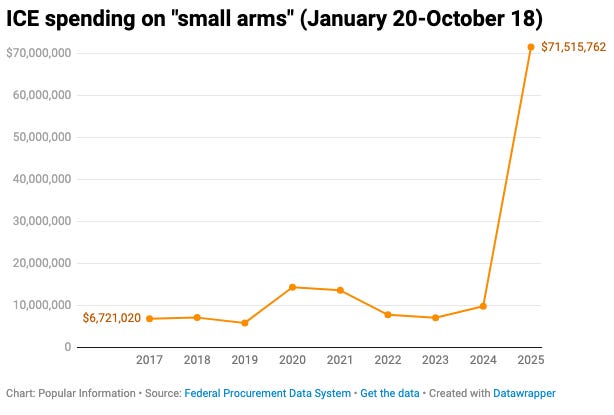
Source: Popular Information
Day 21: Back to business
10,000 👩⚖️ 🏛️
That’s how many federal workers Russ Vought, the director of OMB (Office of Management and Budget), threatened to fire if the shutdown continued. The comments came after a court blocked the Trump Administration from firing roughly 4,200 federal workers the week before.
The law explicitly states workers cannot be laid off during a shutdown. That law was created for this exact purpose, to protect federal workers from being threatened or used as hostages.
U.S. District Judge Susan Illston said the Trump Administration was acting without thinking things through, according to PBS. (Yeah!)
“It’s very much ready, fire, aim on most of these programs, and it has a human cost,” Judge Illston said. “It’s a human cost that cannot be tolerated.”
These political fights are just theater to many politicians; it’s entertainment or reality TV. It shouldn’t come as a surprise if Monday or Tuesday headlines include more layoffs or shutdown threats out of the White House in response to No Kings.
But, as Judge Illston said, these fights have a real human cost.
Democrats are going to have to add demands to their Shutdown List:
Ensure furloughed federal workers receive back pay.
Reinstate anyone laid off.
This fight is about protecting people: the 20 million that will see health insurance premiums skyrocket, the 15 million who will lose Medicaid, the countless more that will lose access to basic health services when their nearby hospital or clinic closes, veterans and military families fighting to make ends meet or receive health care, and federal workers bearing the brunt of the shutdown.
That’s what separates us from the other side — more than policy, more than religion, more than party affiliation, even more than who we voted for in the last election. We want to help people—all people. Trump doesn’t.
Day 20: 7 Million 🪧✊
That’s the estimated number of people who marched last Saturday at more than 4,600 official No Kings demonstrations — not counting the numerous spontaneous meetups here and abroad. That’s more than one protest per federal worker illegally laid off by the Trump Administration two weeks ago.
The June No Kings day drew just under 7 million, and organizers expected 5 million people this time around.
The marches could not have come at a more important time, at day 18 of the government shutdown — just as Democrats have finally found the car keys. And Republicans were running scared from the protests — simultaneously calling them radically dangerous and ‘just full of old people.’ (The protest were a cross section of America — bipartisan, multigenerational, etc.) You know they are scared and confused when they can’t pick which lie to stick with.
Saturday was a much-needed victory for two fights — the one against authoritarianism and the one inside ourselves.
Update: The Senate voted for the 11th time on the GOP budget. It failed with 50 senators voting yes, 43 no, and 7 did not vote.
Day 19: No Kings Highlights

My favorite clip came from overseas in Paris.


No Kings. All 50 States. Let’s practice some ABC.
Day 18: No Kings Day
We’ll tell our kids about today.
How, when the government was shut down, when an armed paramilitary was roving city streets, when the sitting president was threatening to use the U.S. military against U.S. citizens, when federal workers were being illegally laid off, when not even late-night hosts were safe to speak freely, when concentration camps were being built domestically and abroad, when our freedom was being trampled, when our democracy was under threat, we turned the tide of history boldly and peacefully.
If you think Trump isn’t paying attention to No Kings: Today he’s having the military fire artillery shells over I-5 in Southern California, one of the busiest stretches of interstate in the country. VP Vance will be there.
Why? Just because.
He told Gov. Newsom yesterday at the last second and now local officials are scrambling to close the interstate to keep people safe.
“This is a profoundly absurd show of force that could put Californians direclty in harm’s way.” — Newsom via the NYTimes.
More than 2,600 demonstrations are planned for today across the country. That number doesn’t count the random demonstrations in parking lots and street corners of a dozen people that will pop up all over the nation. That number doesn’t count the protests in other countries happening in solidarity with Americans.
To find a place to protest, this super neat map makes it easy:
Or grab a few friends and stand on the corner of a busy intersection or overpass with signs. Stay out of the road. Be safe, but be visible, be loud. It’s that simple. Your visibility today matters, whether it’s 10 of you or 10,000.
If you can’t take to the streets, pick up the phone.
Day 17: No Kings Protests Saturday
Saturday, Oct. 18th, 2025, might be the most important protest in our lifetimes.
I know, I know — you’ve heard this before. The stakes just keep rising.
Trump has taken federal workers hostage, the federal government hostage. He’s threatening Portland, Chicago, Memphis, St. Louis, New Orleans, the list goes on.
Stephen Miller has openly said the president has plenary powers when it comes to using the military on domestic soil.
Russ Vought is threatening to fire 10,000 more federal workers.
Millions of Americans will be put under the thumb of double — triple, quadruple — healthcare premiums by the end of the year.
If we fail in this fight, they will feel vindicated in their actions. They’ll will escalate.
Let’s meet this moment. Let’s send a message to not only to Trump and Republicans in Congress, but to Democrats unwilling to fight, to the politicians treating this as business as usual while the people suffer.
And most importantly, let’s send a message to our kids and grandkids, who will ask us where we were in this moment.
Day 16: What will be left to reopen?
After a certain point, we’ll have to ask ourselves if what reopens is anything more than a technicality — a facade. Will it be the American government we’ve known since the 1940s or just a hollowed-out shell of itself? A police state with ribbons.
More than 4,200 federal employees have been laid off, with Trump threatening thousands more.
More than 750,000 federal employees are furloughed (without pay), and Trump is threatening all sorts of pain — from never bringing some back to not giving back pay to those who do return.
To be clear, both of these moves — the layoffs and the threats of nonpayment — are illegal. And on Wednesday a judge said as much and blocked the attempted layoffs, protecting the 4,200 workers.
The courts have stepped up to check the power of the executive branch. Now Congress must do so as well.
Soon, Democrats will need to add to their list of demands a full reopen — meaning a full reinstatement of anyone laid off during the shutdown and a full reimbursement of backpay as the law explicitly states — a law Trump signed.
Day 15: Highlights from Bernie & AOC Town Hall
The Most Important thing AOC Said:
On Republicans not working:
On healthy masculinity versus toxic masculinity, and how that’s used to divide us:
Day 14: They are already talking about Thanksgiving
In a sign of where things are at, Republicans were already trying to blame Democrats for travel woes… over Thanksgiving. That’s — check’s notes — over a month away.
Not great.
On Tuesday, the Senate failed to pass the GOP spending bill for an 8th time. They also didn’t allow Democrats to hold votes on their spending bill.
Meanwhile, military members will get paid on Wednesday. The Pentagon is moving money around to make payroll this cycle. That eases pressure on Congress… for now.
The next payday for federal workers is Oct. 24th. That will be the first time many of the 750,000 furloughed employees won’t receive any paycheck at all. Most of them received a partial paycheck on Oct. 10th. Another military payday comes shortly thereafter on the 29th.
However, the big deadline now is Nov. 1.
That’s when Obamacare open enrollment starts for 2026, and people will be seeing their new eye-popping premiums as they select healthcare plans.
“The closer to Nov. 1, a lot of these elected officials are going to start hearing from their constituents,” Sen. Ruben Gallego told Politico.
Day 13: Our John McCain Moment
The shutdown fight is about Obamacare. The past 15 years of Republican politics have been about Obamacare. For Tea Party Republicans, it’s been a crusade-like journey to roll back Pres. Obama’s crowning achievement. For Trump, it’s been a vendetta to erase Obama wholesale.
Dress it up different all you want — add more context, less restraint, bigger stakes. This is just a bad reboot. (Not that we much enjoyed the first one.)
This is a sequel to a sequel to a sequel to a remake.
Last time, central casting sent us former Speaker Paul Ryan and his Wisconsin biceps.
PUMP IRON, CUT Medicaid! #GAINS
This time, they sent Speaker Mike Johnson and his gentlemanly Louisiana drawl.
“I do declare, we’ll take your healthcare.”
As much as things change, they stay the same.
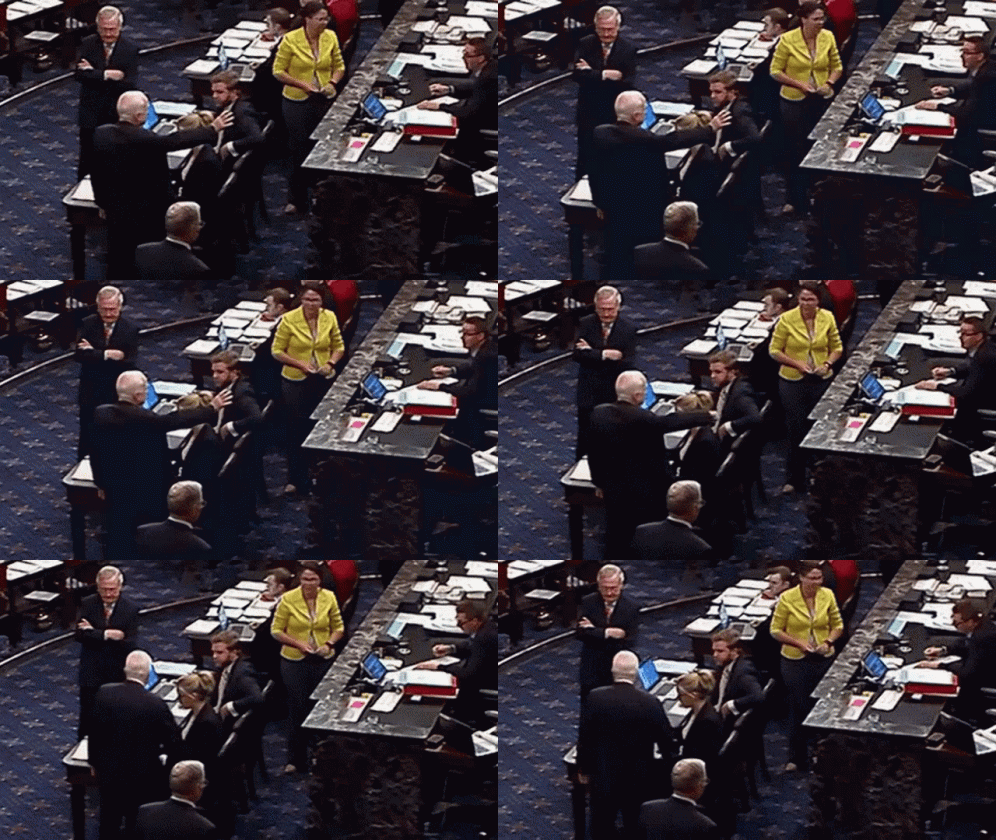
In the last episode (of this, our endless groundhogs day), a big chink in Trump’s armor was exposed when Republican Sen. John McCain walked dramatically onto the Senate floor during an attempt to repeal Obamacare in 2017. He strode up to the lectern, paused, and gave a big thumbs down — killing the effort and saving the ACA. The made-for-TV moment was a blow to the reality TV president.
Here we are again: Defending healthcare for millions of Americans as both a tangible reality and as a symbol against authoritarianism.
This is our Trump II John McCain Moment. We must do it again.
Day 12: Key Republicans to Pressure UPDATED
Sen. Pete Ricketts of Nebraska
Ricketts is up for reelection in 2026 against independent populist Dan Osborn, who has a good shot of taking the seat in a deeply red state. Rural healthcare is the most under threat due to Republican cuts to Medicaid and Obamacare premiums rising. Midwest states like Nebraska will feel this. Clinics and hospitals will likely contract or close.
This is on top of the pain the agriculture economy is experiencing in the state between the ICE raids and tariffs. Ricketts is vulnerable, and voters should make him feel it.
Two ways to do that:
Let him hear it:
Call, write, and show up at his offices. The Oct. 18th No Kings protest should include each field office in Nebraska.
Let him see it:
Support challenger Dan Osborn in any way you can. Make him go viral online, make signs, donate. Nothing would scare the GOP more than seeing a Red State senator underwater.
Winning the Blue Dot: GOP Rep. Don Bacon of Omaha (NE-2)
Staying in Nebraska, Biden won Rep. Don Bacon’s district in 2020. Kamala won it again in 2024. But Republican Don Bacon has kept it by running (slightly) away from Trump when necessary — particularly in 2020. It’s a must-win for Democrats in 2026 and a flippable district.
Again, Nebraska is in the crosshairs of Trumps healthcare cuts, ICE crackdowns, and tariffs. Meanwhile, Omaha has a robust healthcare sector where Medicaid and Obamacare cuts could affect the economy. Additionally, South Omaha is known as the Spanish part of town with a vibrant Latino community.
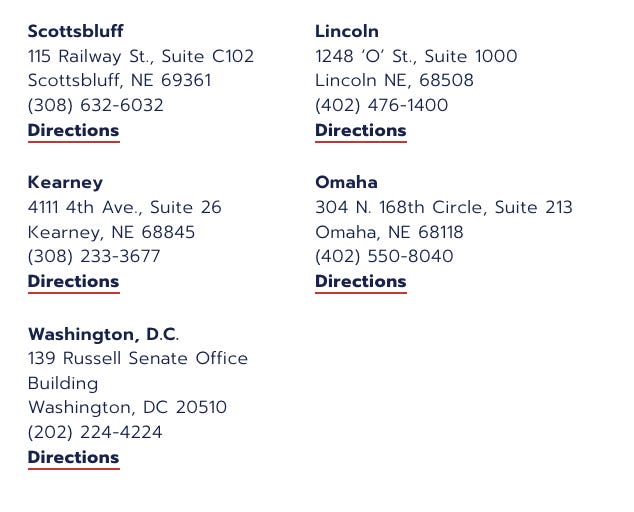
His district office: Omaha Office 13906 Gold Circle, Suite 101. Omaha, NE 68144 Phone: (402) 938-0300. Fax: (402) 763-4947
Rep. Jeff Hurd of Colorado’s 3rd District
Hurd is headed into a tough reelection fight. He serves a district with swaths of rural and frontier land where Medicaid and Obamacare are crucial. Cuts will hurt his constituents. Nearly a third (31%) of his district is covered by Medicaid, the most of any congressional seat in that state. $1.7 billion worth of Medicaid money went into CO-3 last year, a huge economic impact.
While he’s yet to show the courage to buck MAGA, he has expressed more moderate leanings than many of his counterparts.

Sen. Thom Tillis of North Carolina
Tillis is one of the few Republicans left willing to buck MAGA and Trump. That’s why he’s not running for reelection in 2026. He’s not beholden to the political pressure of his GOP counterparts.
Health analysts predict Obamacare premiums will jump nearly 30% on average (almost 10% higher than the national average) in North Carolina if the ACA tax credits expire. For some people it will be drastically higher.
Additionally, the seat is flippable and key for Democrats in 2026. Any sort of movement or action now in that state will help next year in the Midterms.
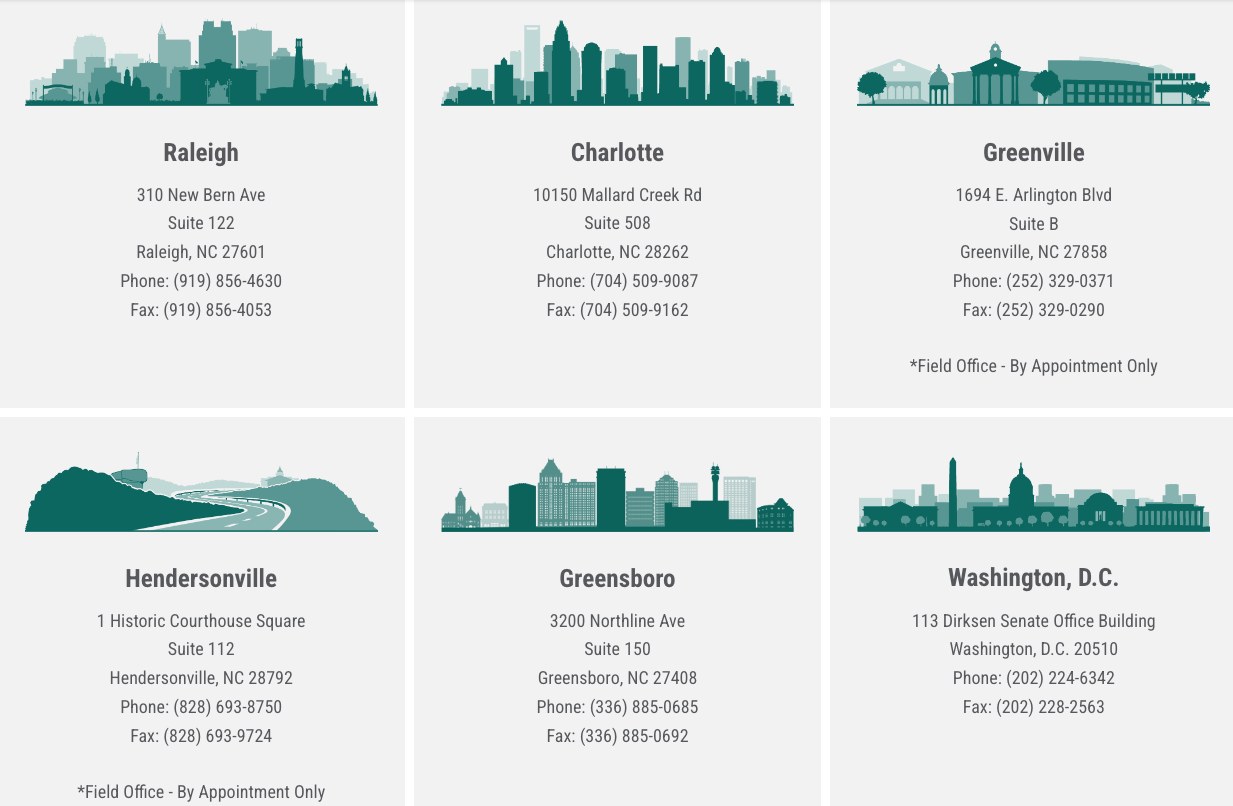
Sen. Susan Collins of Maine
Collins is up for reelection in 2026 and currently underwater in the polls. The seat is Democrats’ most important pickup opportunity in the Midterms. She’s vulnerable and should feel as vulnerable as the constituents she’s leaving out to dry.
Health insurance is set to “skyrocket” in Maine, according to local media. The state could see the highest increase in premiums in the Northeast region. Depending on if you have insurance individually, for a family, or through your work, you could see premiums jump 19% to 32% in Maine.
The jump in cost is due to a few things:
Pharmacy costs are increasing due to tariffs, according to officials.
34,000 people will get kicked off Medicaid.
Hospitals and clinics in the state are worried they won’t be able to cover costs.
Cuts to Obamacare that are currently saving Mainers $50 million this year.
Sen. Collins needs to see that saving healthcare for Americans will also save Maine.
Two ways to help:
Let her hear it:
Call, write, and show up at her offices. The Oct. 18th No Kings protest should include each field office in Maine.
Let her see it:
Support her challengers in any way you can. Make them go viral online, make signs, donate.
I have a current favorite: Graham Platner. He is anti-establishment, anti-oligarchy, and has a message of both strength and empathy that needs to get into the bones of this party.
Sen. Lisa Murkowski of Alaska
The Essential Air Services program, which ran out of money on Sunday, is hugely important for Alaska — both a frontier state and the largest state in the union. The state received $41 million from the program. Some of these communities don’t have roads; air is the only way in or out for medicine and basic supplies.
Meanwhile, Alaska already has the highest healthcare costs in the nation.
Medicaid covers 38% of Alaskans. 1 in 3 births in Alaska were covered by Medicaid.
Health insurance premiums could jump as high as 700% for some people.
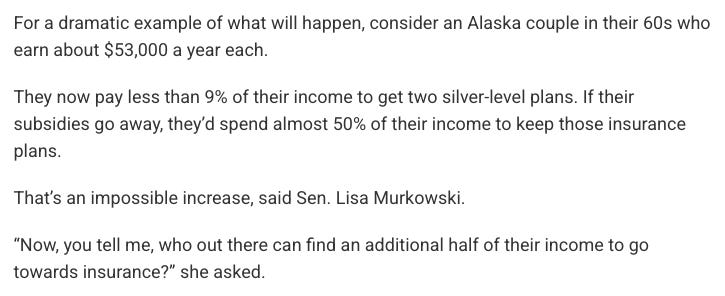
Source: Alaska Public Media
Murkoski Alaska offices

Day 11
Republicans are losing the shutdown fight. This is important not only for defending healthcare for millions of people, not only for making sure hundreds of thousands of federal workers and military members receive their paychecks, but also for breaking Trump’s mirage.
So much of the Trump Administration’s strategy is based on the illusion of inevitability. They want people to think—to feel—as though nothing can stop their march toward authoritarianism. This requires the perception of power they don’t have and a sense of momentum. It requires people and institutions obeying in advance — giving the fascists permission before they’ve even demanded it. It requires a conceit of total compliance.
Now that conceit is cracking.
Democrats in Congress have found their backbone for the first time in nine months. And just this simple, single act of defiance has rattled Republicans.
A majority of Trump supporters want to extend Obamacare tax credits.
Trump districts and states will be the most affected by Republican cuts to Medicaid and Obamacare, and people are starting to figure that out.
Polls show voters are blaming Trump and Republicans for the shutdown, while some polls had it closer to a tie — a bad omen for the incumbent party.
The rubber meets the road this week.
On Sunday, the Essential Air Services ran out of money. The EAS serves 177 rural airports by subsidizing their services. That helps connect those communities to larger cities and airports. This is important for the economy of those rural areas and — again — for healthcare. Those airports connect them to critical medical services.
On Tuesday, the Senate returns to DC.
On Wednesday, military members are scheduled to miss their first paycheck. Trump is pushing Hegseth to avoid that, though it’s unclear if the call is performative or will actually happen.
Most federal workers will receive one more paycheck from their last pay cycle ending on Sept 30th. Meaning they’ll get paid less than they’re owed since three days will be missing from their paystubs. Those workers will not receive a paycheck after that.
This moment is a huge opportunity in the battle to resist authoritarianism. With so many people’s livelihoods at stake, with Trump ignoring courts to use the military against U.S. citizens, the stakes have never been higher. Read more on how to help.
“They are weaker than they look. And it is important that we remember that because what they rely on is the impression of power… They rely on that perception of inevitability and power so that people comply in advance and acquiesce in advance and give up in advance.” — Rep. Alexandria Ocasio-Cortez
Day 10: Republicans didn’t do the homework.
The past 48 hours have revealed that Republicans saw the shutdown as just another political game where they could use brute force to win the messaging battle and continue down their ideological rampage with little care for how it would affect regular people — particularly their own voters.
But numbers don’t lie. Reality is setting in.
The numbers vary, but somewhere between 15-17 million people will lose their health insurance due to GOP attacks on Medicaid. Another 20 or so million people will see premiums jump 100+% if Obamacare tax credits aren’t extended. And let’s be clear: if your monthly health insurance bill doubles — triples, quadruples — in cost per month and you can’t afford it, you don’t have health insurance. If you have to take a deductible that’s so high you’re risking bankruptcy, you don’t have health insurance.
The kicker is this will affect red states and MAGA voters far more, leaving large swaths of the country underinsured, uninsured, and without clinics or hospitals.
Everyone from healthcare CEOs to hospital workers warned about this. Democrats warned about this. Healthcare advocates warned about this. Republicans just thought it was a game. Your healthcare is a game to them.
Now they are realizing all that data, all those warnings, all those people, are real. Some of them have the audacity to stand up to their party, like Rep. Marjory Taylor Greene. But others continue to think they can lie their way out of causing Americans so much pain.
Day 9
Big update: The senate has left town and is not scheduled back until Tuesday.
Major dates coming up:
Most federal workers are set to receive one more paycheck from their last pay cycle ending on Sept 30th. Meaning they’ll get back for those two weeks minus a couple of days.
Those workers will not receive the paycheck after that.
Military workers will not receive a pay check on Oct. 15, much sooner.
This was not on my 2025 bingo card: Marjorie Taylor Greene is talking about people struggling to pay for healthcare and concerns over the expiring ACA tax credits.
This as polls show voters are blaming Republicans for the shutdown. The truth is getting through.
Day 8
Healthcare is so basic, it’s such a low bar. And still we are told it’s too much.
“Standing up for 75 million Americans in this moment to defend the rights of people to go into a little less debt seems like the least they could fucking do.” - Jon Stewart on the shutdown.
Day 7
Update: The Senate will not vote to end the shutdown again until Thursday.
As of Monday, more than 620,000 federal workers had been furloughed.
A reminder: Congress still gets paid during a shutdown.
If ACA tax credits aren’t extended, Obamacare premiums will jump nearly 20% across the country—almost 29% in North Carolina.
Without the changes Democrats are asking for: 15 million Americans could lose their healthcare at the end of the year. As many as 20 million people could see their premiums double.
A personal note:
I have mixed feelings about the shutdown. You probably share some of them.
Shutdowns hurt normal, everyday people. As of Monday, more than 620,000 federal workers had been furloughed thus far. Estimates say they could climb about 100k or more. Those are real people with real mortgages and rents to pay, with kids, with livelihoods and futures on the line.
Generally speaking: Democrats, progressives, and left-leaning voters tend to be against shutdowns because of exactly those things—because we value the dignity of workers and the importance of good governance.
Shutdowns are often political games, messaging battles, brinksmanship, theatre that happen on stage and on TV cameras while normal people have to suffer through it.
Generally speaking, I’m against shuttering our government, just like I’m against gerrymandering. Yet, I find it necessary for California to gerrymander its maps in order to fight against Republican power grabs in Texas and Missouri; I find it necessary to save our democracy.
The budget process is one of the few tools Democrats have while in the minority. Using it feels hopeless (a choice between two poisons); it feels late (this would have been more effective in March); it feels like something the other side would do. And yet, it feels necessary in this moment—necessary to save our republic.
We are in unprecedented times.
Nothing—and I mean nothing—is currently standing in the way of this authoritarian administration’s march to consolidate power. They are moving faster than even the history books suggest a fascist regime would and should.
Standing up, in any way possible, and delivering the first substantive defeat to this White House would be an extraordinary step. It would deliver a body blow and slow Trump’s unchecked power. It would also help the opposition party get up off the floor.
And yet it’s not banks or Fortune 500 companies or billionaires or even politicians having to bear the burden of the fight for freedom and democracy; it’s workers. It’s always workers. That has to change. —Álio
Day 6:
There will be a seventh day after Monday’s Senate vote failed as expected. Republicans refused to negotiate, and Democrats held their line.
In a sign that things are fraying earlier than usual:
This weekend saw ground stoppages at Newark and Denver airports due to a shortage of air traffic controllers. DEN is the 6th busiest airport in the world (and 3rd in the U.S.); Newark is 41st. Trump’s last shutdown in 2019 ended, in part, because air traffic controllers started calling in sick. According to the NYTimes, Transportation Sect. Duffy said there has already been an uptick in controllers calling in sick.
A guest from Navy Federal Credit Union told Marketplace they are seeing more requests for loans at this point in the shutdown compared to 2018-2019. The bank offers zero-interest loans to federal workers for shutdowns to help them cope with the massive financial burden. Is this because federal workers are preparing early for the long haul after a 35 day shutdown last time? Are federal workers already hurting financially?
Trump opened the door to negotiating with Democrats. I was shocked by this. But he reversed course just a few hours later. Was it Trump being Trump? Or is he already feeling the pressure?
Bernie can help you call your GOP senator
His campaign just sent out this message to help mobilize phone calls to Republican senate offices.
You fill out a quick form and it connects you really fast. Here’s the script:
Hi, my name is [your name], and I’m calling to urge you to stop refusing to negotiate with Democrats and to reopen the government.
The current proposal that YOU support would double premiums for 20 million Americans, take away healthcare from 15 million, and do nothing to stop Trump’s authoritarian takeover of the US government.
As your constituent, I’m urging you to vote for a bill to protect our healthcare, stop authoritarianism and fund the government.
Thank you.
Key GOP Members to Pressure
Sen. Susan Collins of Maine is up for reelection in 2026 and is currently underwater in the state. The seat is Democrats’ most important pickup opportunity in the 2026 race. Her independent counterpart, Sen. Angus King, has also voted against a shutdown. This means she’s unlikely to flip if both senators are seeing the same concerns in their constituents. However, her weak position heading into the Midterms means she’s likely more amenable to negotiations, which at this point would be a leap in progress.
Sen. Thom Tillis of North Carolina is one of the few Republicans left willing to buck MAGA and Trump. He’s not running for reelection in 2026 and therefore not beholden to the political pressure of his GOP counterparts. More importantly, health analysts predict Obamacare premiums will jump nearly 30% (almost 10% higher than the national average) in North Carolina if the ACA tax credits expire.
Sen. Pete Ricketts of Nebraska is up for reelection in 2026 against populist Dan Osborn, who has a good shot of taking the seat in a deeply red state. Rural healthcare is the most under threat, with cuts to Medicaid and Obamacare premiums rising. Clinics and hospitals could contract or close. This is on top of the pain the agriculture economy is experiencing in the state between the ICE raids and tariffs. He’s vulnerable, and voters should make him feel it.
The same factors apply to Sen. Joni Ernst of Iowa, who is not running for reelection and might not feel as beholden to Trump’s loyalty tests. An argument for affordability and rural healthcare could make her come to the negotiating table.
Rep. Jeff Hurd of Colorado’s 3rd District is headed into a tough reelection fight. He serves a very rural and frontier district where Medicaid and Obamacare cuts will likely hurt most of his constituents. While he’s yet to show the courage to buck MAGA, he is more moderate than many of his counterparts.
Rep. Don Bacon of Omaha (NE-2) has faced multiple close elections to keep his seat, including when Biden and Kamala won the district in 2020 and 2024, respectively. It’s a very flippable seat, and Bacon has kept it by running (slightly) away from Trump when necessary, particularly in 2020. Meanwhile, Omaha has a robust healthcare sector where Medicaid and Obamacare cuts could affect the economy. All of this means he could see the need for negotiations and compromise.
Day 5: What can we do?
It’s so easy in these moments to sit on the sideline and feel powerless. But the reality is this moment needs our activism more than ever.
Flashpoints like this receive more “bang for your buck” than even massive protests, such as the No Kings nationwide demonstrations months ago. Those occur in a vacuum without a specific ask. General protests like No Kings are great for energy, solidarity, and an overall thumbs down to the status quo. However, they don’t have a specific ask, just an overall “fight back” or a long wishlist of various policy items. But that kind of protest now would deliver a more resounding message and a clear deliverable—extend Obamacare tax credits and reopen the government—and therefore a victory.
Fights without specific deliverables are hard to convert into a clear progress. And tangible progress is extremely important. It’s what voters care about most.
So what can we do?
Support these senators:
Democratic senators in swing states, particularly those up for reelection, need to know voters have their back — and the GOP needs to know that too.
Sen. Jon Ossoff, D-GA
Republicans see Georgia as one of their best pickup opportunities in 2026, and Democrats need to hold the seat if they want any hope in winning the Senate now or anytime in the near future.
If numbers came out that Ossoff suddenly saw a boost in support, that would scare not only his opponents but all congressional Republicans. The best way to do this is by helping him go viral and boosting his standing nationally so his donation numbers go up. (Or if you’re in a position to give, donate directly.) And as always, calling and writing letters of support helps elected officials know they aren’t standing in a field alone.
Sen. Jeanne Shaheen, D-NH
New Hampshire is a Blue-ish state. Democrats win consistently, but it’s always a nail-biter. The state also has one of the more popular GOP governors in the country. All that to say, Sen. Shaheen needs to know what Democratic voters want. She sits on the Appropriations Committee and hates shutdowns. She voted for the budget bill back in March, but she’s a huge supporter of Obamacare and doesn’t want the tax credits to expire.
She is not seeking reelection. (She’s held the seat since 2009.) So this is a matter of making sure she hears from you.
Independent candidate Dan Osborn, NE
GOP Sen. Pete Ricketts is running scared in Nebraska. Osborn nearly beat Sen. Debb Fischer in 2024, and he’s back at it again for 2026. Nebraska farmers are hurting due to ICE crackdowns and tariffs affecting everything from who can work to the cost of their farm equipment to where they can sell their harvests. While Osborn obviously does not have a vote in the shutdown fight, a surge in national profile (and donations) would scare Ricketts and GOP house members in swing districts—like Omaha.
Sen. Brian Schatz, D-Hawaii
Schatz doesn’t need anyone’s money or political support. His state is as blue as the ocean around it. However, Schatz is Schumer’s deputy and one of the Democrats who flipped to avoid a filibuster on the GOP budget back in March. He needs to know there can’t be a repeat of March, especially not now.
Be visible, protest, & demonstrate:
Protest everywhere and all over your communities. These can come in various strategies and sizes.
Head to visible locations like major intersections and protest loudly and clearly from the sidewalk. This way you are telling supporters, “Hey, you’re not alone.” This is a way of telling people on the fence, “Hey, we aren’t trying to get in your way as you drive to work, but just know we are fighting for you too.” And you’re telling people against you, “We are here, and we are not afraid.”
Other locations can include major pedestrian areas, bridges over major freeways, and highly visible locations where you can project strength without causing more pain to the people you’re trying to win over.
Protest at Republican congressional offices, both in the Senate and House. Here, you want to be loud and disruptive. You want members of Congress to feel it, even if they aren’t there. The message needs to get back. Let local media and national politically focused media know that you’ll be there.
Day 4: History
In 1995-1996, two back-to-back shutdowns occurred when Pres. Clinton vetoed two budget bills from GOP Speaker Newt Gingrich. Put simply, Republicans wanted to make major cuts to social services, shift control of Medicaid to the states, increase Medicare premiums, and cut taxes for the wealthy. Sound familiar? The second shutdown lasted 21 days — a then record — and cost $400 million. The public blamed Republicans and Gingrich for the shutdown, and Clinton would go on to win reelection.
This is a lesson for Democrats today.
“If you say ‘Who get’s fired?,’ it always has to be the top. Problems start from the top.” — Pres. Trump on the 2013 shutdown.
Democrats won the last government shutdown against Trump in 2018-2019. That fight lasted 35 days, making it the longest shutdown in U.S. history. It revolved around funding for a border wall. Rep. Nancy Pelosi said no.
The political dynamic of that shutdown was significantly different. The government closed on Dec. 22, 2018. Democrats had just won back that House in the Midterms a month before, and Pelosi regained the speaker gavel midway through the shutdown.
Additionally, the message and fight were clear: border wall money. Americans did not see Trump’s pet project as a worthy reason to shut down the federal government.
Republicans capitulated on Jan. 25, 2019. The shutdown cost $5 billion, and 380,000 people were furloughed.
If Democrats want a repeat victory, they 1) need to have Pelosi’s tenacity and 2) need to make clear to voters what this is about: healthcare.
A Democratic win = healthcare stays cheaper for Americans.
A Democratic loss = healthcare costs go up for Americans.
Can Democrats win that messaging battle?
Day 3: An attack on Blue States & RIP the Hatch Act
On Wednesday, the administration closed Colorado’s regional hub for the patent office, laying off 30 people and forcing another 300 to move back to DC. There’s not much money to be saved on this; it’s just vindictive. They left the hub in Texas open.
But let’s be clear: This was already planned and had nothing to do with the shutdown—just like nearly all the cuts we’ll see in the coming days.
“This is an effort to intimidate the whole of society.” — Sen. Adam Schiff
On Thursday, Trump cut $8 billion in clean energy funds for Blue states. Money for two infrastructure projects in New York City was cut. ICE and military operations are becoming more violent and aggressive in Portland and Chicago.
They were going to do all this anyway. The shutdown is a pretext, window dressing.
Meanwhile, Trump is weaponizing federal agencies and breaking federal law
Multiple agencies posted pop-ups and banner messages blaming “The Radical Left” and Democrats for the government shutdown. Some federal workers were also forced to place similar messages on their out-of-office email.
This is a clear violation of the Hatch Act, an ethics law that does not allow federal workers and agencies to use tax money for political purposes. It’s why members of Congress cannot fundraise (or dial for dollars) from their offices in the Capitol—they have to walk across the street.


However, Congress is not stepping up, the Dept. of Justice is acting as Trump’s personal law firm, and the Supreme Court seems apt to grant Trump all the deference of an authoritarian.
The founders created a balance of power system based on the idea that personal ambition checks personal ambition. They leveraged human nature and psychology to keep authoritarian power grabs in check. This system does not work with the cult of a strongman.
Day 2: Let’s set the table
Questions I always ask in these chaotic moments:
Who stands to gain here—financially or politically?
What is their motivation?
What does “winning” look like to them?
From the perspective of Pres. Trump, the government can stay closed or reopen; It doesn’t much matter to his administration. The White House will use federal money however they please—“open” government or not. They’ll make their layoffs and cuts, rescind and impound funds, shovel more money towards ICE, and continue their unrestrained march toward a unitary president.
Trump will reopen the federal government if he sees a TV ratings advantage in doing so, but that’s about it. If left to his own devices, he’ll never reopen. He sees the shutdown as an extraordinary opportunity to consolidate power towards the system of government he truly wants—a monarchy.
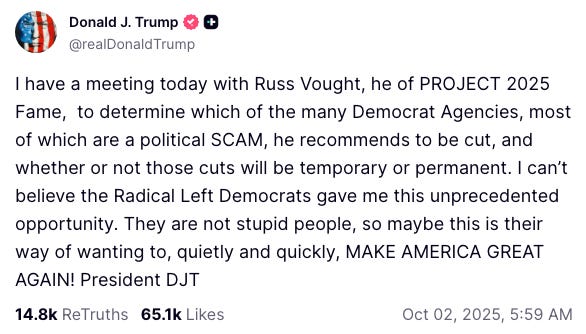
Congress is the only group with an interest in reopening, and it will all come down to which side capitulates first.
Democrats in Congress needed to take a stand (finally), and they used one of the few weapons available to the party out of power. They leveraged the budget rules to negotiate on one of the only issues where voters still trust them: protecting healthcare.
If Democrats blink, Republicans will celebrate the win, and the Trump cuts will continue anyways. A Democratic collapse will leave people, particularly federal workers and Democratic voters, wondering three things:
What was this all for?
Here they go losing again…
Are these people up for the task? Are they worth anything?
If Republicans negotiate, Democrats will have kept Medicaid and Obamacare alive—saving some families as much as $1400 a month in healthcare costs. That win would be on par with the late Sen. John McCain’s infamous thumbs-down vote, when he joined Democrats in rejecting a Trump attempt to repeal Obamacare in 2017.
And Democrats need a win—both for their own party and for voters who view them as feckless in the face of fascism.
AOC, Bernie, and their friends in Congress need activists and voters now more than ever. They need you.
Day 1: Is this the last government shutdown?
There’s a chance that we just witnessed the shutting down of the federal government for the last time. This is not a certainty, perhaps not even likely.
But for the first time in modern history, it’s a distinct possibility.
There was a strangeness in the procedural nature—normality—of the shutdown. Yes, we have the endless headlines, the typical finger-pointing and brinksmanship and high-stakes rhetoric—all part and parcel of a funding showdown. But, in the long scheme of things, it was routine.
I can’t help but think: Are we quietly acting as if this is business as usual when we’ve just witnessed the end of the U.S. republic? Is this how liberty dies? Not with thunderous applause, but with the banality of parliamentary procedure? — Alio
Is there a chance the U.S. government never reopens?